
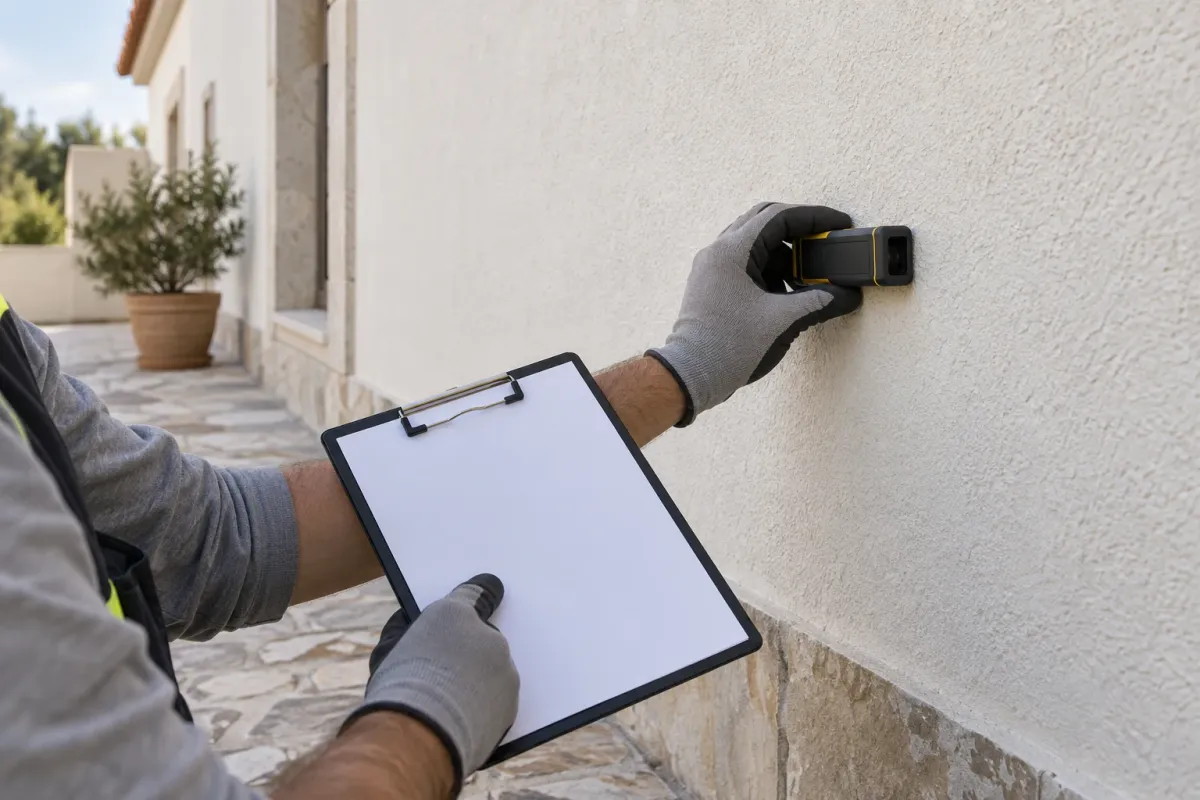
1. Send every contractor the same enquiry
Prepare a common description covering location, building type, surfaces and observed problems. Include labelled photographs and your preferred timetable. If you do not yet know whether painting is sufficient, say so; do not ask every contractor to confirm a solution chosen before assessment.
Keep the version sent. When a visit reveals relevant information, update the file and ask proposals to state their assumptions. Without a common starting point, a price table can create a misleading impression of objective comparison.
Define the purpose of the enquiry: explore alternatives, price an agreed scope or investigate a problem. Mixing these aims can produce very different documents, all described as quotations.
For a house, use the exterior painting planning guide to prepare that shared scope.
Compare detailed preparation with a simple painting item
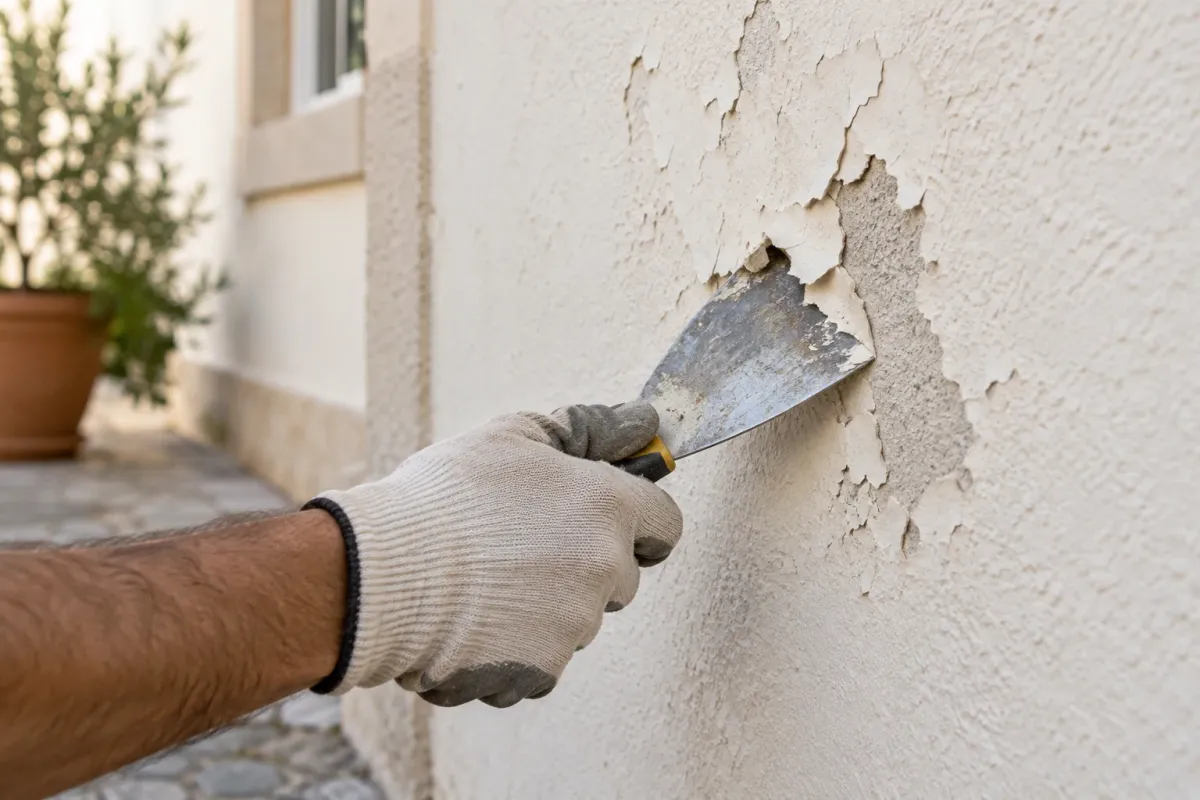
The scraping visible in the photograph is an operation to look for in a quotation when the coating is coming loose. A proposal limited to washing and painting does not necessarily describe this preparation or the repairs that follow.
How to approach this situation
- Align the elevations and areas included, using the same measurement rules and treatment of openings.
- Compare preparation, products, access, protection of nearby areas, exclusions and stated taxes line by line.
- Request written clarification of necessary operations that are missing, and check how discoveries after preparation will be handled.
What determines the decision
The total becomes a useful criterion after this comparison. A vague line may conceal a different scope without demonstrating anything about the contractor’s quality.
What to check at the end
Keep the comparison table and the final approved proposal. No price published online replaces a quotation for the assessed building.
2. Align surfaces and measurement methods
Check that each proposal covers the same elevations, boundary walls, outbuildings and details. Ask how openings are treated. Net wall area should not be compared directly with an area measured on another basis.
A difference in area does not automatically prove an unjustified price. First obtain the measurement schedule and connect it to included work. Use “to confirm” for missing information; filling a cell by intuition makes the comparison less reliable than the original quotations.
3. Compare preparation and the system
Preparation can be the main difference between proposals naming the same paint brand. Look for repairs, removal, levelling and areas where the scope still depends on assessment.
Ask for full product references. A sheet may specify several applications or particular conditions; for instance, Nováqua HD states two to three applications. This is not a universal coat count or the total number of stages in the project. CIN — Nováqua HD.
Where a proposal offers an alternative, ask what changes in the work and expected result. An external insulation option should be presented as a different intervention from repainting.
4. Use a comparison matrix
Copy the fields below for two or three quotations. Its value lies in written answers, not an automatic score. One unresolved critical issue can prevent a decision even when the rest looks complete.
| Item | Quote A | Quote B |
|---|---|---|
| Surfaces | Identification and measurement | Identification and measurement |
| Preparation | Work and extent | Work and extent |
| Cracks and damp | Assessment, treatment or exclusion | Assessment, treatment or exclusion |
| Products | Complete system | Complete system |
| Access and protection | Included or excluded | Included or excluded |
| Terms | Timing, payment and stated taxes | Timing, payment and stated taxes |
| Additional work | Approval process | Approval process |
| Final documents | Work and maintenance records | Work and maintenance records |
5. Request useful clarifications
Ask short questions about differences preventing comparison: “Is the rear included?”, “What preparation does this price cover?” or “Is access equipment in the total?”. Answers should be attached to the quotation or incorporated into a revised version.
If an item cannot be finalised before preparation, ask why and how it will be confirmed. An identified uncertainty can be legitimate. Establish who decides, how it is measured and when a change is approved.
Do not negotiate by removing a stage without understanding its role. If the budget needs adjustment, ask for separate scope alternatives, such as an identified phase with clear limitations and dependencies.
6. Compare totals after scope
Once questions are resolved, relate the price to the work. Include payment conditions, exclusions, access and documents supplied. Do not combine unrelated market figures to manufacture a personalised project estimate.
Example without rates: quote A includes only the house elevations; B also includes both faces of the boundary walls. Before judging the totals, request equivalent surfaces or separate prices by scope. Apply the same reasoning to repairs and access equipment.
The painting costs page explains relevant factors. Market references help frame questions; they are not an offer for your property.
7. Confirm the version that will govern the work
The accepted quotation should be identifiable by date or version. Attach colour choices, written answers and agreed changes. Confirm the execution contact and final inspection points.
This approach helps on small projects and becomes especially useful when several people decide. For apartment buildings, the facade work organisation guide helps prepare and manage the shared file.
If the quotation includes interior rooms, separate that scope from the facade. See interior painting and the room-by-room preparation guide to identify walls, ceilings, protection and additional elements.
Editorial information to help prepare your decision. The cited sources support technical statements; examples and checklists provide general guidance. The proposed solution and work are confirmed during the building assessment.
What would you like to renew in your home?
Provide the location and describe the problem. An overall view and a detail photograph help prepare the first conversation.
Request a facade assessment ↗Aveiro · Ílhavo · Vagos · Gafanha da Nazaré. View service areas and assessment arrangements.