
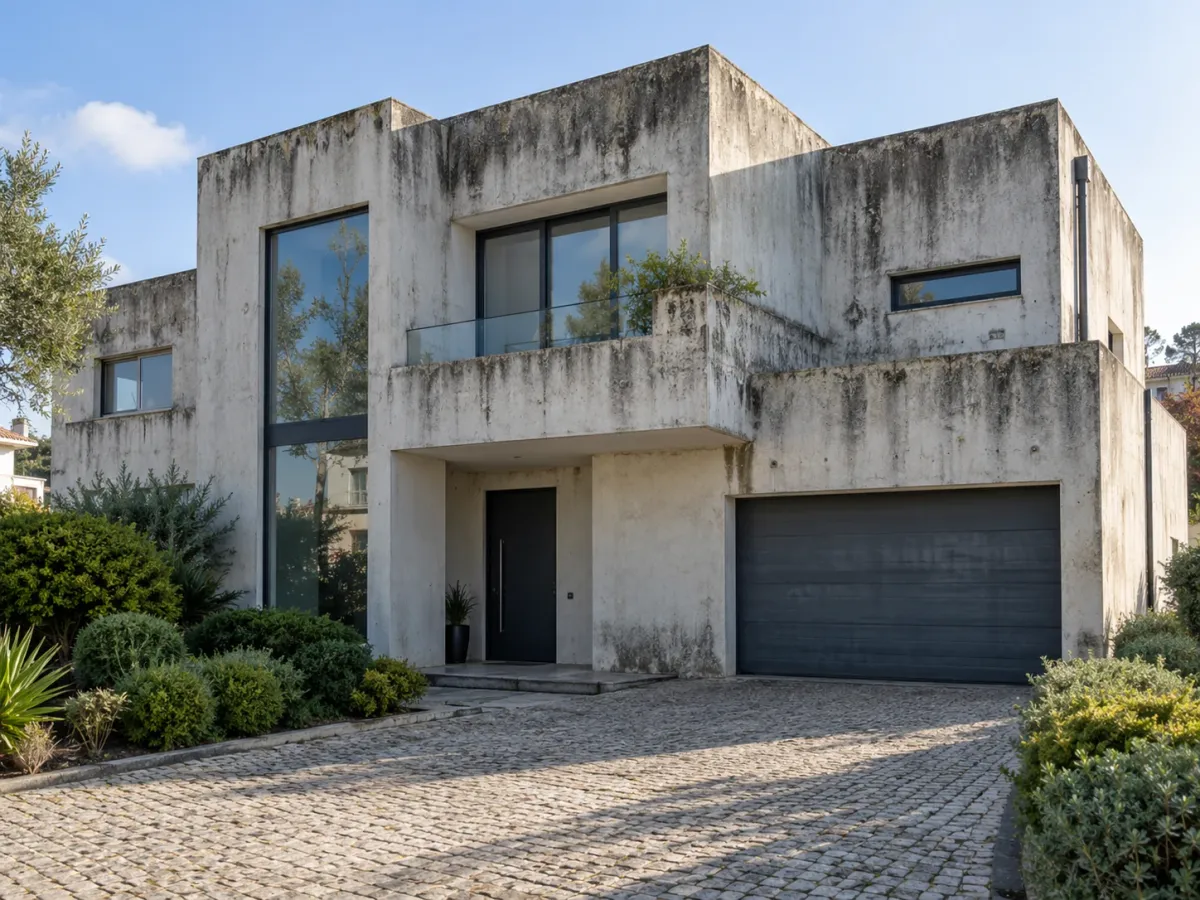
1. Establish an initial reference
Gather available photographs and choose repeatable viewpoints. Identify each elevation and relevant features: openings, boundary walls, downpipes and equipment. Record the date and a brief description of visible condition.
After recent work, include the final quotation, products, changes and maintenance instructions. If the system is unknown, record that uncertainty. An honest record is more useful than a form filled with an assumed brand.
In an apartment building, keep the file so future administrations can receive it. For a house, store it with other property documents. Maintenance should not depend solely on one person remembering a conversation with the applicator.
Photograph the same junction to track marks
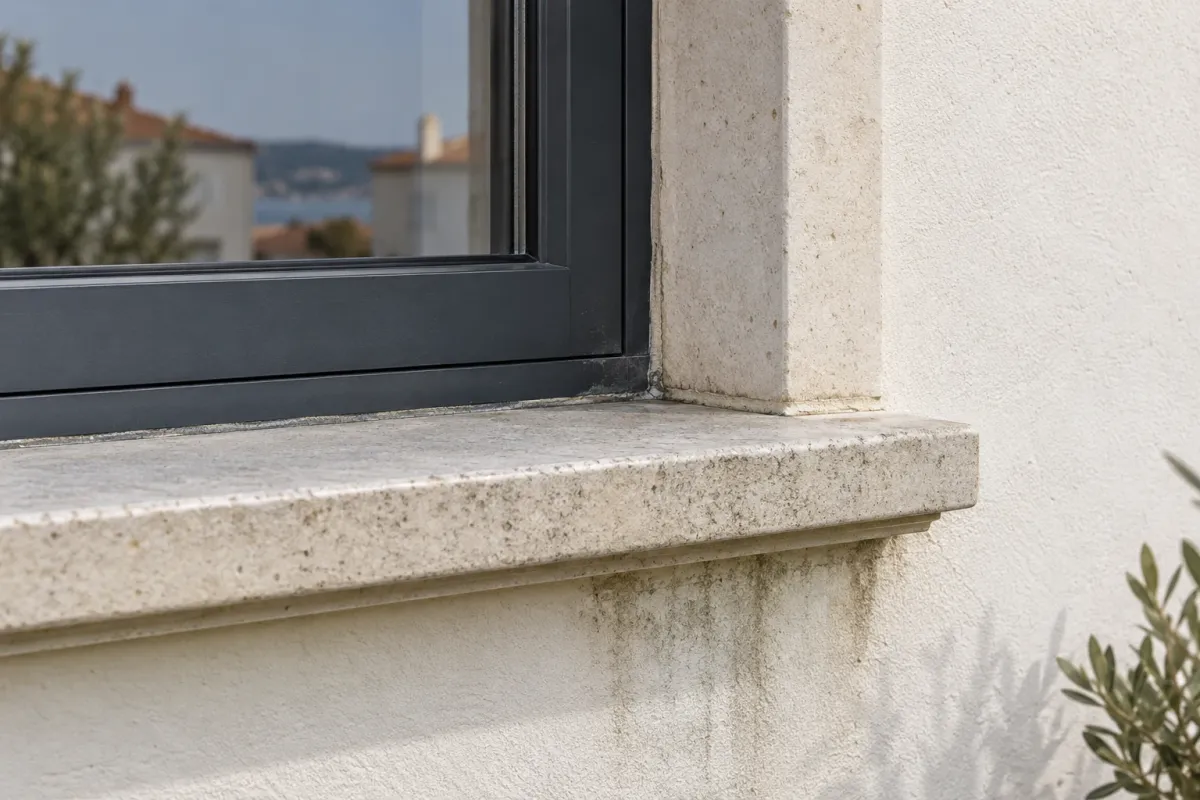
Marks are visible below the window sill. Repeating the viewpoint, with the date and observed conditions, makes comparison over time easier and helps prepare an assessment if the area changes.
How to approach this situation
- Take an overall view and a close-up from ground level, recording the date and observed circumstances.
- At a later observation, compare its apparent size, the coating condition and any corresponding indoor signs.
- Request assessment if the mark returns, spreads or accompanies deterioration; a changing defect should not wait for a maintenance date.
What determines the decision
Monitoring documents change. On its own, it cannot diagnose the cause of water ingress or a crack.
What to check at the end
Keep photographs, finish references and known interventions together so the next professional consulted can use the record.
2. Observe without unsafe inspection
Homeowner observations should be made from safe positions. Do not climb the facade to touch loose material or measure defects. Close inspection requiring work at height should be organised by properly equipped professionals.
Look for visible changes: loose coating, new cracks, recurring stains, streaks, marks near fixtures or altered patches from old repairs. Describe what you see and where, without trying to classify severity alone.
Falling material or circulation beside an unstable area needs an appropriate safety response. It should not be treated simply as deciding when to repaint.
3. Use a short monitoring record
A form you can complete is better than a long checklist you abandon. Create one entry for each observation, linked to photographs. Compare with the previous view before concluding a defect is new.
| Field | What to record |
|---|---|
| Date and elevation | Observation date and wall identification |
| Observed sign | Simple description without assumed diagnosis |
| Location | Floor, opening or nearby feature |
| Development | Comparison with the previous photograph |
| Context | Rain, work or known alteration |
| Next step | Record, ask a question or request assessment |
Add earlier work references and the responsible contact where useful. Avoid unnecessary personal information in images, especially when the file will be shared.
4. Distinguish cleaning, repair and renewal
A stain does not automatically define the intervention. Identify the objective and establish whether the cause needs assessment. Removing plant growth, repairing a defect and changing the finish are separate decisions.
Weber describes weberantimousse for moss and plant residues. A cleaning product with defined uses illustrates why the method should suit the substrate rather than assuming any wash treats any mark. Weber — weberantimousse.
Ask what will be removed or treated, which surfaces are included and how the result will be checked. If the purpose is cosmetic, state that clearly. An uncertain cause should not be presented as resolved.
If the building already has external insulation, the guide to ETICS system components helps you collect the documentation for assessment.
5. Pay attention to altered areas
After replacing a window, installing equipment or repairing a gutter, add the intervention to the file: contractor, date and scope. A later sign nearby can then be described with relevant context.
Where capoto is installed, mention the system before new fixings or repainting.
Observe junctions that can be seen safely. If marks appear beneath a sill or near a downpipe, include the feature in the photograph. Proximity guides assessment but does not prove causation.
6. Adapt the plan to the building and its actual exposure
This guide does not set a universal cleaning or repainting interval. Agree inspection frequency and review criteria from the system, documentation and observed condition. An event that changes the facade may justify another inspection.
In the Aveiro region and coastal locations, describe the property’s actual exposure rather than assuming every house in the same area behaves alike. Orientation, nearby elements and maintenance history should be assessed on site.
An unconditional durability promise does not replace a maintenance plan. Ask what to observe, which methods are compatible and when to contact the person responsible for the system.
7. Record every completed intervention
After cleaning or repairs, keep the work description, products, date and photographs. Identify unresolved points. The record should remain understandable when read months or years later.
If a stain returns, use comparable images for the next enquiry. Do not automatically repeat the same treatment without reassessment. The history exists to support a better next decision.
For an assessment, provide the location, observed sign and development through the facade painting page. If renewal of the finish is being considered, consult the repainting preparation guide.
For cleaning work, see the facade cleaning service and cleaning planning guide. The quote should distinguish maintenance, preparation for painting and problems needing further assessment.
Editorial information to help prepare your decision. The cited sources support technical statements; examples and checklists provide general guidance. The proposed solution and work are confirmed during the building assessment.
What would you like to renew in your home?
Provide the location and describe the problem. An overall view and a detail photograph help prepare the first conversation.
Request a facade assessment ↗Aveiro · Ílhavo · Vagos · Gafanha da Nazaré. View service areas and assessment arrangements.